

Planning a road trip across the UAE in 2026? Whether you’re cruising along Sheikh Zayed Road, heading to Jebel Hafeet, or exploring the vast Liwa dunes, choosing the right car can make or break your journey.
Table of Contents
| # | Section | Type |
|---|---|---|
| 1 | Why the UAE Is One of the World’s Great Road Trip Destinations | H2 — Intro/Hook |
| 2 | What Makes a Great UAE Road Trip Car — The Four Things That Matter | H2 — Decision Framework |
| 3 | The Best UAE Road Trip Routes From Sharjah — And the Car Each One Needs | H2 — Route Guide |
| 4 | Best Cars for Desert and Off-Road Driving in the UAE | H2 — Off-Road Guide |
| 5 | Best Cars for Family UAE Road Trips | H2 — Family Guide |
| 6 | Best Cars for Solo and Couple UAE Road Trips | H2 — Solo/Couple Guide |
| 7 | Best Cars for Long Highway Drives Across the UAE | H2 — Highway Guide |
| 8 | The Complete UAE Road Trip Car Comparison Table | H2 — Master Table |
| 9 | What to Pack in Your Rental Car for a UAE Road Trip | H2 — Practical Planning |
| 10 | Road Trip Driving Tips Every UAE Renter Should Know | H2 — Driving Guide |
| 11 | Why AIA Cars Rental Is the Perfect Road Trip Partner | H2 — Trust/Authority |
| 12 | Final Thoughts — The UAE Is Waiting. Pick Your Car and Go | H2 — Conclusion/CTA |
| 13 | Frequently Asked Questions | H2 — FAQ Schema |
Why the UAE Is One of the World’s Great Road Trip Destinations
More Than Skyscrapers and Shopping Malls
Most people who visit the UAE for the first time arrive with a mental image built from photographs — the Burj Khalifa reaching into a hazy sky, the Palm Jumeirah curling out into the Gulf, the gold souq glittering under fluorescent light. It’s a perfectly accurate image of one version of the UAE. But it’s an image that captures maybe fifteen percent of what this country actually is, and the other eighty-five percent is what road trippers discover when they get behind the wheel and start driving.
Within two hours of Sharjah in any direction, the landscape changes so completely and so dramatically that it is difficult to believe you are in the same country. Head east on the E88 and the flat urban sprawl gives way to the Hajar Mountains — sharp, ancient, rust-coloured rock formations rising out of the desert floor with a suddenness that genuinely takes your breath away the first time you see it. Keep driving and the mountains open up onto the east coast, where the Indian Ocean stretches to the horizon in shades of blue and green that look more like the Maldives than anything you’d expect to find in the Arabian Gulf region. Head south toward Mleiha and the red sand dunes rise in sweeping curves that seem to belong to a different planet entirely. Head north to Ras Al Khaimah and the Hajar range reveals a different, more dramatic face — jagged peaks, narrow valleys, and a raw, wild beauty that feels completely untouched.
The UAE has a geography that was made for road trips. The distances are manageable, the roads are excellent, the destinations are genuinely extraordinary, and the contrast between what you find in one place and what you find two hours away is more dramatic than most countries ten times its size can offer. This is not a country you understand from a hotel room or a tour bus. You understand it from the driver’s seat, with the windows up against the heat and a clear road stretching ahead of you toward something you haven’t seen yet.
What a UAE Road Trip Actually Looks Like
A UAE road trip doesn’t look like a European road trip, and it doesn’t try to. There are no winding country lanes lined with hedgerows, no charming village cafés every twenty kilometres, no unpredictable weather that turns the day into a weather management exercise. What there is instead is something uniquely and specifically Arabian — wide, immaculately maintained roads cutting through landscapes of extraordinary scale and beauty, service stations that are clean and well-equipped and positioned exactly where you need them, and a clarity of light and sky that makes every landscape photograph you take look like it was professionally edited.
The pace of UAE road tripping is its own thing too. You can cover Sharjah to Fujairah in ninety minutes on a smooth, well-signposted highway and spend the rest of the day entirely at your destination without feeling like the journey ate the day. Or you can slow it down deliberately — stop at the viewpoints on the mountain pass, pull over at a roadside fruit stall for fresh dates and cold water, take the long way around the east coast with no particular timetable and no particular pressure. Both approaches work. The roads accommodate whatever pace you bring to them, and that flexibility is one of the things that makes UAE road tripping so genuinely enjoyable rather than a logistical exercise in covering distance.
Why Sharjah Is the Perfect Road Trip Starting Point
Sharjah sits at the geographical heart of the northern UAE in a way that makes it an almost ideal base for road trip exploration. From central Sharjah you can reach Fujairah and the east coast in ninety minutes, Abu Dhabi in under two hours, Hatta in around ninety minutes, and Ras Al Khaimah in an hour. The Mleiha desert is forty-five minutes away. The Musandam Peninsula in Oman is within a comfortable half-day’s drive. Almost every significant UAE destination is within reach of a day trip, which means you don’t have to choose between the destinations — you can experience several of them across the course of a single week-long rental without ever feeling rushed.
The road network out of Sharjah is also exceptionally well connected. The E11, E311, E88, and E66 all radiate outward from the emirate with the kind of clear, well-maintained infrastructure that makes navigation straightforward even if you’re driving unfamiliar roads for the first time. Signage is consistent and appears in both Arabic and English, GPS works reliably throughout the UAE including in mountain areas, and the fuel station network is dense enough that range anxiety is simply not a factor in your planning.
What you need to make the most of all of this — the destinations, the routes, the landscapes, the freedom — is the right car. Not just any car that gets you from one place to another, but the specific vehicle that fits your group, your route, your comfort requirements, and the terrain you’re going to encounter. That’s exactly what this guide is built to help you find. Take a moment to explore AIA’s full fleet for your road trip and you’ll immediately see the range of options available — from fuel-efficient city cars that handle paved UAE routes effortlessly to the Nissan Patrol that was practically designed for this country’s most demanding terrain. The right vehicle for your road trip is in that fleet. This guide will help you identify exactly which one it is.
What Makes a Great UAE Road Trip Car — The Four Things That Matter
Not Every Good Car Is a Good Road Trip Car
There is an important distinction that most people don’t think about until they’re already on the road — the difference between a car that’s good for daily use and a car that’s genuinely good for a road trip. These two categories overlap, but they’re not the same thing. A compact city car that’s perfectly wonderful for navigating Sharjah’s streets and parking in tight spots can become a genuinely uncomfortable companion on a three-hour round trip to Abu Dhabi with two adults, two children, and a boot full of luggage. A car that feels spacious and impressive in a car park can feel underpowered and thirsty on a sustained highway run through the desert heat.
Road trips expose a car’s character in ways that short urban journeys simply don’t. You spend enough time in the vehicle that small discomforts become significant ones. You cover enough distance that fuel efficiency stops being a minor consideration and becomes a meaningful cost variable. You encounter enough variation in road type and terrain that the car’s composure and capability start to matter in ways they never would on a twenty-minute city run. Getting this choice right before you set off is the difference between a road trip you talk about enthusiastically for years and one you remember for the wrong reasons.
There are four things that matter most when evaluating any car for a UAE road trip specifically. Not ten things, not a long checklist of marginal considerations — four core criteria that apply to every route, every group size, and every destination this country has to offer. If a vehicle scores well on all four, it’s a strong road trip car. If it falls short on even one of them, you’ll feel that shortfall somewhere along the way.
Comfort Over Long Distances — Non-Negotiable
The UAE’s road trip distances are not enormous by global standards — we’re talking about journeys of one to three hours in most cases, not the transcontinental drives of North America or Australia. But sustained highway driving in the UAE heat, with the air conditioning working hard and the road stretching ahead in a long, flat line, is more tiring than the distance alone suggests. A car with a firm, unsettled ride, inadequate seat support, or a cabin that feels cramped after thirty minutes becomes significantly more difficult to tolerate after two hours than it did at the start of the journey.
Comfort on a UAE road trip means several specific things. It means a seat that supports the lower back properly on sustained drives rather than one that feels fine for the first twenty minutes and progressively less so after that. It means a cabin that absorbs road noise and wind noise at motorway speeds well enough that a conversation doesn’t require raised voices. It means an air conditioning system that cools the entire cabin effectively — not just the front seats — because the UAE sun through the rear glass creates a heat load that underpowered air conditioning simply cannot manage on a full car. And it means enough headroom and legroom in both front and rear seats that nobody is contorting themselves to stay comfortable over the course of a long drive.
This criterion alone eliminates the smallest economy cars from serious road trip consideration for anything beyond a solo trip or a couple with very light luggage. The Kia Picanto is an excellent city car in every respect that matters for city driving. On a ninety-minute mountain road to Fujairah with two passengers and bags in the boot, its limitations become considerably more apparent.
Boot Space — More Than You Think You’ll Need
The boot space problem on a UAE road trip follows a very predictable pattern. People pack what they think they’ll need, load the car, and discover that reality has been considerably more generous than their mental packing list suggested. Then they add the beach gear for the Khor Fakkan stop, the cool box they decided at the last minute was essential, the extra layer they brought because UAE evenings in winter are cooler than most people from warm countries expect, and the shopping from the Friday market in Fujairah on the way back.
Boot space on a road trip is not what you need on day one with a freshly packed, optimistically minimal bag. It’s what you need on day four when the trip has accumulated the inevitable collection of additional items that road trips always generate. Planning around the generous end of your boot space requirement rather than the minimal end is the approach that serves you better over the full duration of the rental.
As a practical guide for UAE road trips specifically: a couple traveling light can manage with a sedan’s standard boot — the Nissan Versa’s above-average boot space makes it the most practical choice in this category. A family of four with proper luggage needs a crossover or compact SUV as a minimum. A large family or a group with camping or beach equipment needs the Nissan Patrol’s cavernous boot without compromise or creative packing.
Reliability on Varied Terrain
The UAE’s road network is excellent, but “excellent” covers a wide range of surface types and conditions depending on where your road trip takes you. The E11 between Sharjah and Abu Dhabi is smooth, wide, and perfectly maintained — any vehicle handles it without difficulty. The E88 mountain road through the Hajar range to Fujairah is equally well-surfaced but involves sustained gradients, tight corners, and the kind of driving that asks more of a car’s brakes, transmission, and power delivery than a flat highway run ever does. And once you venture off sealed roads entirely — into the desert near Mleiha or onto graded tracks in the mountain foothills — the requirements shift dramatically and only a genuinely capable off-road vehicle belongs on that terrain.
Reliability on varied UAE terrain means choosing a vehicle whose capability matches the most demanding element of your planned route. A well-maintained sedan is entirely reliable on every sealed road in the UAE — the Toyota Corolla SE and Nissan Sentra will handle the E88 mountain road with complete confidence and have been doing exactly that for years. But they have no business on soft sand or serious off-road tracks, and using them there is not just inadvisable from a mechanical standpoint — it creates a safety situation that a more capable vehicle would have avoided entirely.
Fuel Efficiency — Because UAE Road Trips Cover Real Distance
A Sharjah to Abu Dhabi return trip covers around 320 kilometres. Add a loop through Al Ain and you’re at 450 kilometres for the day. A proper east coast trip — Sharjah to Fujairah, along the coast to Khor Fakkan, back via Dhaid — covers 250 to 300 kilometres. These are not small distances, and on a week-long road trip that takes in three or four different destinations, the total mileage adds up to a number that makes fuel efficiency a genuine budget consideration rather than a marginal one.
The good news, as covered in detail in the previous blog in this series, is that UAE petrol prices are among the most affordable in the world. Even a fuel-hungry Nissan Patrol won’t break the bank at UAE pump prices. But the difference in weekly fuel cost between an economy sedan and a full-size SUV covering 800 kilometres of road trip mileage is still a real number — somewhere between AED 120 and AED 200 depending on the specific vehicles being compared. For a budget-conscious solo traveler or a couple trying to keep the overall trip cost manageable, choosing a more fuel-efficient vehicle is a meaningful saving that goes toward accommodation, experiences, and food rather than the fuel tank.
The Four Criteria — At a Glance
These are the four things to hold in your mind when you evaluate any vehicle for your UAE road trip. Score each one honestly against your specific situation and the right vehicle category will become clear:
- Long-distance comfort — seat quality, cabin space, noise levels, air conditioning capacity for a full car in UAE heat
- Boot space — not what you’re packing now, but what you’ll be carrying by the midpoint of the trip
- Reliability and terrain capability — matched honestly to the most demanding road your route includes
- Fuel efficiency — calculated against your realistic weekly mileage, not an optimistic estimate
With these four criteria clearly in mind, browse AIA Cars Rental’s road trip ready fleet and you’ll find yourself looking at each vehicle through a much more useful lens than price alone. The right road trip car for your specific situation is identifiable — you just need the right framework to find it, and now you have one.
The Best UAE Road Trip Routes From Sharjah — And the Car Each One Needs
The Routes That Make the UAE Worth Driving
There is something deeply satisfying about planning a road trip with a proper map — real destinations, real distances, real driving times — rather than a vague intention to “explore.” The UAE rewards this kind of deliberate planning because its destinations are genuinely distinct from each other and genuinely worth the drive, and because knowing what lies ahead lets you choose the right vehicle from the start rather than discovering halfway through a mountain pass that you’ve brought the wrong car.
Every route in this section starts from Sharjah — because Sharjah is where AIA Cars Rental operates, where most of the customers reading this guide will be picking up their vehicle, and because Sharjah’s central position in the northern UAE makes it one of the most logistically sensible starting points for exploration in any direction. These are not theoretical routes constructed from a map — they are drives that people make regularly, that residents use for weekend escapes, and that tourists discover and immediately want to repeat.
Sharjah to Fujairah and Khor Fakkan — The East Coast Classic
If there is one road trip that every person with a rental car in Sharjah should make at least once, it is the drive east across the Hajar Mountains to the UAE’s east coast. The route takes you out of the flat, urban landscape of the western UAE and into a completely different world within the space of about ninety minutes — a world of dramatic mountain passes, narrow wadis, roadside date palm farms, and eventually the extraordinary blue water of the Indian Ocean stretching away to the southeast.
The drive itself on the E88 is one of the most genuinely beautiful stretches of road in the country. The mountain section — beginning roughly after you pass through Dhaid and the landscape starts to rise around you — involves sustained gradients and sweeping bends through rust-coloured rock formations that look like something from a geography textbook about ancient geological forces. The road is well-maintained and properly marked throughout, but it asks more of a car than a flat highway run does — the engine works harder on the climbs, the brakes work harder on the descents, and the bends require actual steering input rather than the gentle course corrections of motorway driving.
Fujairah city itself is worth an afternoon — the old fort overlooking the town is one of the oldest in the UAE, and the waterfront area has a relaxed, unhurried atmosphere that feels completely different from the western coast cities. But the real destination for most people is Khor Fakkan, twenty minutes north up the coast — a bay town with genuinely beautiful turquoise water, a long sandy beach, excellent snorkelling on the reef just offshore, and several good restaurants where fresh fish arrived that morning from boats you can see anchored in the bay. It is one of those places that people visit once and immediately start planning when they can go back.
For this route, a well-chosen sedan handles the mountain road with complete confidence. The Hyundai Elantra and Nissan Sentra are both excellent choices — enough power to handle the gradients without the engine feeling strained, composed and stable on the mountain bends, and fuel-efficient enough on the subsequent coastal driving that the running costs stay sensible. For a family or a larger group, the Nissan Rogue Sport or the Nissan Patrol turns the same journey into a more spacious, more commanding experience without changing the route’s character.
Sharjah to Hatta — The Mountain Escape
Hatta occupies a unique position in the UAE road trip canon — it is technically part of Dubai emirate, but it feels nothing like Dubai. Surrounded by the Hajar Mountains and accessed via a drive that takes you briefly through Omani territory before re-entering the UAE, Hatta is a mountain village with a genuine heritage district, a beautiful reservoir that turns the most spectacular shade of blue-green depending on the light, kayaking and paddle boarding on the dam, mountain biking trails that wind through rocky terrain, and a pace of life that makes the UAE’s coastal cities feel like they belong to a different country.
The drive from Sharjah takes around ninety minutes on a good day via the E44 through Dubai and then the E77 toward the mountains. The road is smooth and well-maintained throughout, and the landscape transitions from urban to semi-arid to properly mountainous in a way that keeps the drive interesting rather than monotonous. The last section before Hatta, as the road winds into the mountains proper, is particularly enjoyable — the kind of driving where you find yourself slowing down slightly not because the road demands it but because the scenery deserves more than a passing glance.
Leave early on a Friday morning to beat the crowds — Hatta is one of the UAE’s most popular weekend destinations and the car parks at the dam and the kayaking area fill up quickly once the morning gets going. Take the Toyota Corolla SE or the Hyundai Elantra for a couple or a small group, or step up to the Nissan Rogue Sport if you’re traveling with a family and need the additional boot space for a day’s worth of outdoor equipment.
Sharjah to Abu Dhabi — The Grand Highway Drive
The Sharjah to Abu Dhabi drive is the UAE’s great highway experience — long, open, fast, and covering the full length of the country’s western corridor in a way that gives you a genuine sense of the UAE’s scale and ambition. The E11 between the two cities is one of the finest stretches of motorway in the region — wide, smooth, well-lit, and maintained to a standard that would make most European road authorities genuinely envious. At its best, in light traffic on a clear morning, it is the kind of highway that makes driving feel like a genuine pleasure rather than a means to an end.
Abu Dhabi itself justifies the drive entirely on its own terms. The Sheikh Zayed Grand Mosque — one of the most beautiful buildings in the world by any reasonable measure — is reason enough for the journey if you haven’t seen it. The Louvre Abu Dhabi on Saadiyat Island is a genuinely world-class museum in a building of extraordinary architectural beauty. Yas Island has Ferrari World, Warner Bros. World, and a Formula One circuit that offers driving experiences when it isn’t hosting races. The Abu Dhabi Corniche is a long, beautifully maintained waterfront that rewards an evening walk in the cooler months. There is more to do in Abu Dhabi than a day trip covers — which is an excellent reason to turn the drive into an overnight stay rather than a return journey the same day.
For this route, the mid-range sedans are the natural choice and they make the drive feel genuinely enjoyable rather than merely functional. The Nissan Sentra Full Option and Toyota Corolla SE are particularly well-suited — composed at sustained motorway speeds, fuel-efficient over the 160-kilometre distance, and comfortable enough in the cabin that a three-hour round trip doesn’t leave anyone feeling like they need to recover before the day’s exploring can begin.
Sharjah to Ras Al Khaimah — The Northern Adventure
Ras Al Khaimah is the UAE’s most underrated emirate by a considerable margin, and the drive north from Sharjah on the E11 coastal highway is one of the more enjoyable journeys in the country — the road hugs the edge of the Hajar range with the mountains rising dramatically on one side and occasional glimpses of the Gulf coast on the other, and the ninety-kilometre distance takes just over an hour in normal traffic.
RAK, as it’s almost universally known among UAE residents, offers a genuinely different experience from its southern neighbours. The Jebel Jais mountain road — the UAE’s highest paved road at over 1,900 metres — is a driving experience that genuinely deserves its own paragraph. The road winds up through the Hajar range in a series of sweeping bends and tight hairpins, opening up increasingly dramatic views over the mountain valleys below, and concludes at a viewing platform where the landscape looks like something from a helicopter documentary. It is extraordinary, and it is entirely accessible in any of AIA’s fleet vehicles — no special capability required, just a car that’s well-maintained and driven with appropriate respect for the gradient and the bends.
RAK also has Al Hamra, one of the UAE’s oldest coastal villages, and a stretch of undeveloped coastline that provides a genuinely different beach experience from the manicured resort beaches of Dubai. For a shorter road trip or a first UAE road trip with a new rental car, the Sharjah to RAK route is the ideal introduction — manageable distance, varied and interesting driving, and a destination that consistently surprises people who haven’t been before.
Sharjah to Mleiha — The Desert Experience
Mleiha is the closest genuinely dramatic desert experience to Sharjah — forty-five minutes southeast of the city, the landscape transitions from urban outskirts to sweeping red sand dunes and rocky desert terrain that encompasses some of the UAE’s most significant archaeological sites. The Mleiha Archaeological Centre is one of the finest heritage attractions in the entire country, and the surrounding desert offers the kind of scale and silence that is genuinely difficult to find anywhere near a major UAE city.
This is the route where the vehicle choice is most consequential of all the destinations in this guide. The sealed road to the Mleiha Archaeological Centre and visitor facilities is accessible in any vehicle. But the dune driving and desert tracks that make Mleiha truly memorable — the red sand formations, the fossil sites, the elevated viewpoints that reveal the full dramatic scale of the landscape — require a properly capable off-road vehicle. Not a crossover, not a high-riding hatchback, but a genuine four-wheel-drive SUV with the capability to handle soft sand without getting stuck in it.
In AIA’s fleet, this means the Nissan Patrol 2025, full stop. Everything else in the fleet belongs on sealed roads and performs brilliantly there. The Patrol belongs everywhere — sealed roads, mountain passes, desert sand, graded tracks — and it handles all of them with the kind of calm competence that comes from a vehicle specifically engineered for exactly this environment.
Route to Recommended Car — Quick Reference Table
| Road Trip Route | Distance from Sharjah | Drive Time | Road Type | Best Car Type | Best AIA Model | Daily Rate |
|---|---|---|---|---|---|---|
| Sharjah to Fujairah and Khor Fakkan | 130km | 1.5 hours | E88 mountain highway | Sedan or SUV | Hyundai Elantra or Nissan Patrol | AED 100–POA |
| Sharjah to Hatta | 120km | 1.5 hours | E44 and E77 mixed highway | Sedan or SUV | Toyota Corolla or Nissan Rogue Sport | AED 110–125 |
| Sharjah to Abu Dhabi | 160km | 1.75 hours | E11 open highway | Sedan or SUV | Nissan Sentra or Nissan Patrol | AED 105–POA |
| Sharjah to Ras Al Khaimah | 90km | 1 hour | E11 coastal highway | Any category | Mazda 3 or Nissan Kicks | AED 100 |
| Sharjah to Mleiha Desert | 40km | 45 minutes | Desert off-road | Full SUV only | Nissan Patrol 2025 | POA |
| Sharjah to Al Ain | 200km | 2 hours | E66 inland highway | Sedan or SUV | Toyota Corolla or Nissan Patrol | AED 110–POA |
| Sharjah to Musandam Oman | 180km | 2.5 hours | E88 mountain and coastal | Full SUV | Nissan Patrol 2025 | POA |
For tourists wanting to plan their destinations and activities around these drives in more detail, the Visit UAE official tourism website is an excellent resource — comprehensive destination guides, attraction information, and practical visitor advice that pairs perfectly with having a rental car and the freedom to explore at your own pace. Once you’ve settled on your route, book your Sharjah road trip car with AIA and the team will make sure the right vehicle is ready for you when your adventure begins.
Best Cars for Desert and Off-Road Driving in the UAE
The Part of the UAE That Changes Everything
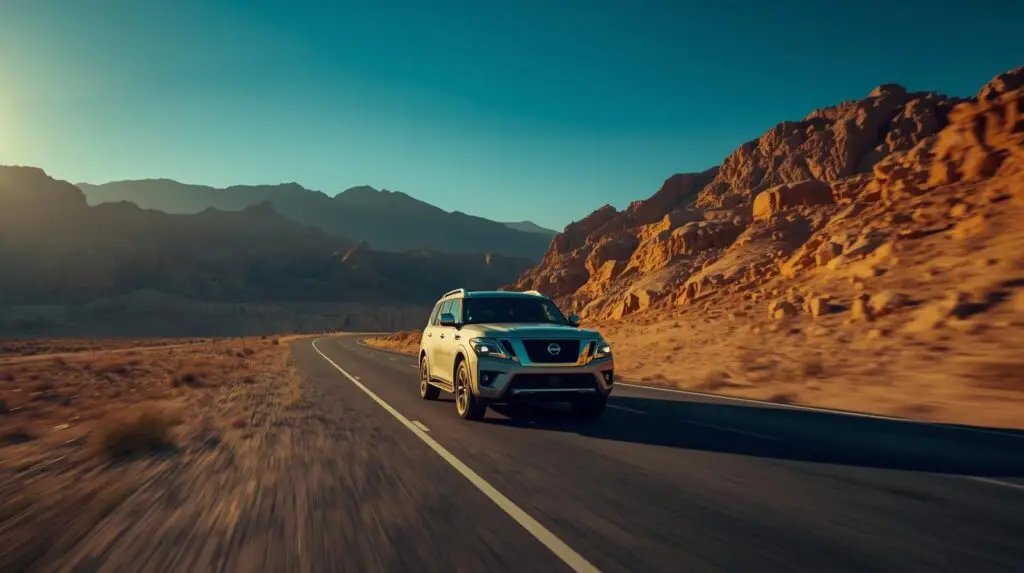
There is a moment that happens to almost every person who drives into the UAE desert for the first time — a moment where the road ends, or rather where the road becomes something else entirely, and the landscape opens up in a way that no photograph and no amount of description fully prepares you for. The red sand dunes near Mleiha rise in long, sweeping curves against a sky that is almost offensively blue. The silence is extraordinary. The scale is disorienting in the best possible sense — you feel simultaneously very small and very fortunate to be exactly where you are.
This version of the UAE is completely real and completely accessible. It is forty-five minutes from central Sharjah. It requires no special permits, no guided tour booking, no elaborate planning. What it requires — and this is the part that genuinely matters — is the right vehicle. Because the desert does not forgive the wrong choice. Sand that looks firm and navigable from a distance can swallow the wheels of an unprepared vehicle within seconds. A car that handles motorway driving and mountain roads with complete confidence can become completely immovable in soft sand within metres of leaving a sealed surface. The consequences of getting this wrong range from mildly embarrassing to genuinely dangerous depending on how far from help you’ve managed to get before things went wrong.
This section is about making sure that never happens to you — by understanding clearly which vehicles belong in UAE desert terrain, why the distinction matters so much, and what you need to know before you point any car toward a desert track.
Why UAE Desert Terrain Demands a Specific Vehicle
The physics of driving on sand are fundamentally different from the physics of driving on tarmac, and understanding this at even a basic level explains immediately why vehicle choice matters so much on desert terrain. On a sealed road, your tyres maintain consistent contact with a firm, predictable surface. Grip is reliable, steering inputs translate directly and immediately into directional changes, and the vehicle’s weight works in your favour by keeping the tyres pressed firmly onto the road surface.
On soft sand, everything changes. The surface is neither firm nor consistent — it shifts under the weight of the vehicle, and the deeper the sand, the more it shifts. A vehicle with insufficient ground clearance touches the desert floor before its wheels have found purchase and becomes effectively beached — sitting on its undercarriage with its wheels spinning in soft sand and going nowhere. A vehicle without low-range four-wheel drive capability distributes its power incorrectly for sand driving, sending torque to wheels that have lost traction rather than those that still have it. A vehicle with road-oriented tyres generates insufficient surface area contact with the sand to generate the traction needed to move forward with any control.
None of this is particularly complex physics. It is simply a set of requirements — ground clearance, four-wheel-drive capability, appropriate power delivery — that most vehicles in a standard rental fleet do not meet, and that one vehicle in AIA’s fleet meets comprehensively. That vehicle is the Nissan Patrol 2025, and in UAE desert terrain it is not the best choice — it is the only responsible choice.
The Nissan Patrol 2025 — The UAE’s Off-Road Icon
The Nissan Patrol has been the UAE’s most trusted and most beloved off-road vehicle for decades, and it has earned that position through the straightforward mechanism of being genuinely exceptional at the thing the UAE’s landscape demands of it. This is not a vehicle that was designed for European motorways and then adapted for occasional light off-road use. The Patrol was built for exactly the terrain the UAE and the wider Arabian Peninsula presents — extreme heat, soft sand, rocky wadis, and the kind of sustained, demanding off-road work that exposes the limitations of less capable vehicles within minutes.
The 2025 Nissan Patrol in AIA’s fleet represents the current generation of a vehicle that has been progressively refined through decades of real-world use in exactly this environment. The ground clearance is substantial — high enough that the vehicle’s undercarriage clears the desert surface even in moderately soft sand conditions. The four-wheel drive system is genuinely capable rather than merely nominally present — it includes the low-range gearing that allows controlled, deliberate movement through sand at the kind of speeds that maintain momentum without digging in. The suspension travel absorbs the uneven, unpredictable surfaces of desert and mountain terrain without transmitting every bump and rock directly to the occupants in the way that a road-oriented suspension setup would.
Inside, the Patrol is a genuinely comfortable vehicle regardless of the terrain it’s covering — seven properly sized seats, a well-equipped cabin that manages to feel spacious even when all seven seats are occupied, and an air conditioning system capable of cooling the entire cabin effectively even under the extreme heat load of full UAE summer sun beating down on a large vehicle. It is the only vehicle in which you can take a family of seven into the UAE desert with confidence that both the terrain and the comfort requirements of the journey are fully covered.
Off-Road Vehicle Suitability — How the Fleet Compares
| Vehicle | Ground Clearance | 4WD Capable | Sand Performance | Rocky Terrain | Off-Road Rating |
|---|---|---|---|---|---|
| Nissan Patrol 2025 | High | Yes — full 4WD with low range | Excellent | Excellent | 5 out of 5 |
| Nissan Rogue Sport | Medium | No — front wheel drive | Not recommended | Limited on graded tracks only | 2 out of 5 |
| Nissan Kicks | Medium-Low | No | Not suitable | Not suitable | 1 out of 5 |
| Hyundai Elantra | Low | No | Not suitable | Not suitable | 0 out of 5 |
| Toyota Corolla SE | Low | No | Not suitable | Not suitable | 0 out of 5 |
| Kia Picanto | Low | No | Not suitable | Not suitable | 0 out of 5 |
The table above is not designed to make any vehicle other than the Patrol look inadequate — every other vehicle in AIA’s fleet is entirely excellent on the sealed roads it was built for. The point is simply to be completely honest about what belongs on desert terrain and what does not, so that nobody ends up in a situation they could have avoided with the right information in advance.
What to Know Before You Drive Off-Road in a Rental Car
Choosing the right vehicle is the most important step in responsible UAE desert driving, but it is not the only step. There are several things that every renter planning any off-road driving should understand and act on before they set off — not to add bureaucratic complexity to what should be an exciting adventure, but because each of these points exists to protect you, the vehicle, and the people you’re driving with.
Tell AIA when you book. This is the most important practical step on this list. If your planned route includes any off-road driving — even a relatively modest detour onto desert tracks near Mleiha — inform the AIA team when you make your reservation. This is important for insurance reasons, for making sure the specific vehicle prepared for you is appropriate for off-road use, and for ensuring that the team knows your intended route in case you need roadside assistance. Attempting to use a rental vehicle in ways that weren’t disclosed at booking creates complications that are entirely avoidable with a thirty-second conversation at the point of reservation.
Never drive desert terrain alone. This applies regardless of your experience level and regardless of how capable your vehicle is. The UAE’s desert areas are genuinely remote in places, and soft sand can immobilise even a well-driven Patrol if conditions are particularly challenging or an unexpected dip in the terrain catches the driver unprepared. Having a second vehicle — ideally with another experienced driver — means that if one vehicle gets stuck, there is a recovery option immediately available rather than a long wait for help to arrive from a significant distance. If you don’t have a second vehicle in your group, join an organised desert excursion with experienced guides who know the terrain.
Reduce your tyre pressure before you drive on sand. This is one of the most consistently overlooked pieces of desert driving advice and one of the most practically important. Lower tyre pressure increases the contact area between the tyre and the sand surface, which dramatically improves traction and reduces the likelihood of digging in. A standard road tyre pressure of 32 to 35 PSI needs to come down to around 18 to 22 PSI for comfortable desert driving. Always carry a portable tyre inflator so you can bring the pressure back up before returning to sealed roads — driving on tarmac at desert pressures damages tyres and handling. The AIA team can advise on the right pressure for the Patrol you’re renting if you’re unsure.
Read the terrain before you commit to it. Desert sand looks deceptively uniform from a distance but varies enormously in terms of depth and firmness across quite short distances. Darker sand tends to be firmer than lighter sand. Tracks where other vehicles have recently driven tend to be more compacted and therefore safer than completely untracked dune faces. Steep dune faces should always be approached at the correct angle — straight up or straight down, never diagonally across the face, which risks rolling the vehicle. If you’re new to desert driving, stay on established tracks and popular dune areas where the terrain is more predictable and help is more accessible.
Know where you are. UAE desert areas are genuinely remote and GPS signal, while generally reliable, can behave unpredictably in some mountain and deep desert areas. Download offline maps of your intended area before you leave cellular coverage, carry a fully charged power bank for your phone, and make sure at least one person in your group knows your planned route and expected return time. AIA’s 24/7 support line means help is always a phone call away — but that call is much easier to make if you can describe your location accurately.
The Bottom Line on Desert Driving
The UAE’s desert is one of the most extraordinary natural environments in the world and it is genuinely worth experiencing from the ground level — not from a tour bus window, not from a helicopter, but from the driver’s seat of a capable vehicle with the dunes rising around you and nothing between you and the landscape but warm desert air. It is an experience that stays with people in a way that a city tour or a beach day simply does not.
Getting there safely and responsibly requires the Nissan Patrol, proper preparation, and the honest acknowledgment that desert driving has real requirements that cannot be substituted or approximated. Meet those requirements and the desert rewards you with something genuinely unforgettable. If you’re ready to make that trip, rent the Nissan Patrol for your UAE desert adventure through AIA and the team will make sure everything is in place before you head into the dunes.
Best Cars for Family UAE Road Trips
The Logistics of Family Road Tripping in the UAE
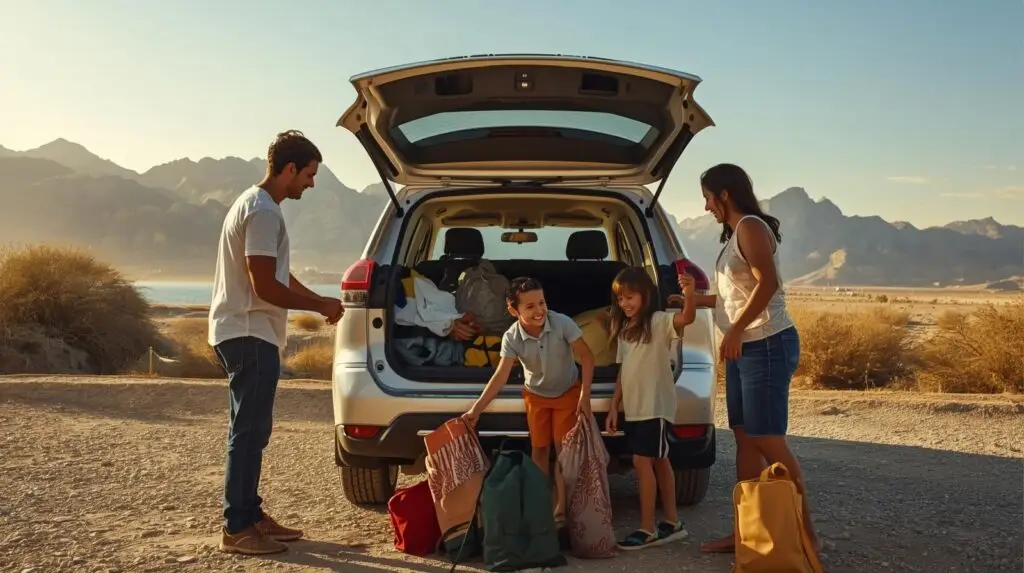
Family road trips have a particular energy to them that solo and couple travel simply doesn’t replicate. There is more excitement in the preparation, more genuine joy at the destinations, and — let’s be completely honest — more complexity in the logistics. Getting a family into a rental car for a UAE road trip involves a set of considerations that don’t exist when it’s just two adults and a single bag between them. Child seats need to be arranged. The boot needs to swallow a meaningful quantity of luggage plus whatever beach equipment, snacks, and entertainment the journey requires. The air conditioning needs to reach the back seat effectively. The rear legroom needs to be sufficient that the children aren’t complaining about being squashed before you’ve cleared the city limits.
None of this is insurmountable — millions of families drive UAE roads every year and the experience, when the vehicle is right, is genuinely wonderful. The key phrase there is “when the vehicle is right.” A family squeezed into an undersized car for a ninety-minute mountain drive isn’t just uncomfortable — it sets a negative tone for the entire trip that takes time and effort to recover from. The right vehicle, on the other hand, turns the drive itself into part of the experience rather than something everyone is silently hoping will be over soon.
The UAE is one of the world’s great family road trip destinations precisely because its geography offers so much variety within such manageable distances. Beaches, mountains, heritage sites, adventure parks, desert landscapes — all of them within reach of a morning’s drive from Sharjah. A family with the right rental car can cover more genuinely exciting ground in a week than most destinations offer in a fortnight, and the memories made along the way — the moment the mountains appear through the windscreen on the E88, the first sight of Khor Fakkan’s turquoise water, children utterly astonished by the scale of the Abu Dhabi mosque — are the kind that don’t fade.
What Families Actually Need on a Long UAE Drive
Strip away the marketing language and the aspirational photography and what a family actually needs on a long UAE road trip comes down to four very practical things. Space — enough of it, in both the passenger cabin and the boot, that nobody is compromising for the duration of the journey. Reliability — because a vehicle that develops a problem two hours from Sharjah on a mountain road with children in the back is a situation that needs to be avoided rather than managed. A genuinely effective air conditioning system — because the UAE sun through the rear windows of a car creates a heat load that a marginal air conditioning system cannot handle, and children are less tolerant of heat discomfort than adults. And a smooth, comfortable ride — because a car that transmits every road surface imperfection into the cabin transforms a ninety-minute drive into a ninety-minute endurance test for every small person in the back seat.
Every vehicle AIA maintains meets a consistent standard of servicing and reliability — that commitment is one of the fundamentals of how the company operates and it covers the entire fleet regardless of price point. But the space requirements, air conditioning capacity, and ride quality requirements of a family road trip narrow the field considerably from the full fleet to the specific vehicles genuinely suited to this use case. Let’s go through them honestly.
The Seven-Seater Question — When Do You Really Need It?
The Nissan Patrol’s seven-seat capacity is genuinely necessary for some families and genuinely unnecessary for others, and it’s worth being clear about which situation you’re actually in before you default to the largest vehicle available.
A family of five — two adults and three children — needs the Patrol. A standard five-seat vehicle technically accommodates five people, but “technically accommodates” and “comfortably fits for a ninety-minute road trip” are different things when three children are sharing a rear seat. The Patrol’s third row provides proper seating for the additional passengers rather than the compromised, folded-in additional seats that some vehicles offer — seats that are acceptable for short journeys and genuinely uncomfortable for anything longer.
A family of four — two adults and two children — has options. The Nissan Rogue Sport’s rear seat accommodates two children comfortably with proper legroom and headroom, and its boot handles a family’s luggage with room to spare. For a family of four on a UAE road trip that doesn’t involve off-road driving, the Rogue Sport is an excellent and more fuel-efficient alternative to the Patrol that covers the family’s actual requirements without the additional running costs of a full-size SUV.
A family of three — two adults and one child — has even more flexibility. The Hyundai Elantra’s rear seat is genuinely spacious for a single child and the boot handles a family’s day trip equipment without difficulty. For a budget-conscious family of three planning road trips on sealed UAE roads, the Elantra at AED 100 per day delivers genuine family-trip comfort at a price point considerably below the SUV category.
Family Road Trip Vehicle Comparison
| Vehicle | Seats | Boot Space | Child Seat Compatible | Long Drive Comfort | Best Family Route | Daily Rate |
|---|---|---|---|---|---|---|
| Nissan Patrol 2025 | 7 | Excellent | Yes — all rows | Excellent | Any UAE route including off-road | POA |
| Nissan Rogue Sport | 5 | Very Good | Yes | Very Good | Fujairah, Hatta, Ras Al Khaimah | AED 125 |
| Hyundai Elantra | 5 | Good | Yes | Very Good | Abu Dhabi, Fujairah, Al Ain | AED 100 |
| Toyota Corolla SE | 4 | Good | Yes | Very Good | Abu Dhabi, Al Ain, long highway routes | AED 110 |
| Nissan Kicks | 4 | Good | Yes | Good | Shorter routes, Ras Al Khaimah | AED 100 |
| Nissan Versa | 4 | Very Good | Yes | Good | Airport runs, moderate road trips | AED 80 |
Child Seats — Sort This Out Before Anything Else
UAE law requires appropriate child restraints for young passengers and this applies in rental cars exactly as it applies in privately owned vehicles. Infants need rear-facing infant seats. Toddlers need forward-facing child seats. Older children who have outgrown a standard child seat need a booster seat until they meet the height and weight requirements to use an adult seatbelt safely. These are legal requirements enforced seriously — not optional extras that you can choose to skip.
AIA can arrange baby seats and child seats as part of your rental, but this must be requested when you book rather than on the day of pickup. Be specific when you request — the child’s approximate age and weight helps the team make sure the right seat category is ready for you rather than a generic child seat that may not be appropriate for your child’s size. A few lines of detail at the booking stage means the right equipment is ready and properly fitted when you collect your vehicle, and the family road trip starts exactly as it should — smoothly, safely, and without anyone standing in a car park trying to figure out a child seat installation at the beginning of what should be an exciting day.
Family Road Trip Preparation Tips
These are the practical details that make the difference between a family road trip that goes smoothly and one that generates the kind of memories that are only funny in retrospect:
Pack more water than you think you need. The UAE’s climate — even in the cooler winter months — creates a hydration requirement that is higher than most families from temperate climates are accustomed to planning around. A cool box in the boot with cold water and drinks for the journey is not a luxury on a UAE road trip, it is a genuine practical necessity, particularly with children on board.
Plan your rest stops in advance. The UAE’s major road trip routes have well-equipped service stations and rest areas at regular intervals — the E11 between Sharjah and Abu Dhabi has multiple clean, well-maintained stops, and the E88 toward Fujairah has rest areas in the mountain section where the views make a stop genuinely worthwhile rather than just necessary. With children, planning a stop every sixty to ninety minutes is a sensible rhythm that keeps the journey manageable and the back seat significantly calmer.
Time your departure for early morning. Leaving Sharjah before 7am on any road trip day gives you the best of the UAE’s road conditions — minimal traffic, the coolest part of the day for the car’s air conditioning to work at its most efficient, and arrival at your destination before the crowds build up at the most popular spots. The east coast beaches at Khor Fakkan before 9am are a genuinely different and better experience than arriving at midday when every family in the northern UAE has had the same idea.
Brief the back seat before you leave. Every family has their own version of the back seat briefing — the quiet conversation with the children about what the day involves, how long the drive is, and what the expectations are for behaviour in the car. UAE road trips reward this preparation particularly because some of the drives are long enough that children without a clear sense of what’s coming can become genuinely difficult before the journey is half done. The Fujairah drive at ninety minutes is manageable. The Abu Dhabi return at three-and-a-half hours total is a more serious undertaking that benefits from preparation.
For families planning a sightseeing-heavy trip who would prefer not to navigate unfamiliar roads while also managing children in the back seat, AIA also offers a chauffeur-driven service that covers exactly this kind of family travel — allowing the adults to focus entirely on the experience rather than the navigation. To see this and all other available options, view family-friendly vehicles at AIA Cars Rental and the full range of services the team provides for family travelers in Sharjah and across the UAE.
Best Cars for Solo and Couple UAE Road Trips
The Lightest, Freest Version of UAE Road Tripping
There is something genuinely liberating about a solo or couple road trip that group travel, for all its joys, simply cannot replicate. No schedules negotiated between competing preferences. No rest stop debates. No back seat commentary on your choice of route or driving style. Just you — or you and one other person who shares your appetite for the open road — and the full, unfiltered experience of the UAE’s extraordinary landscape unfolding at whatever pace feels right on the day.
Solo and couple road trippers in the UAE have a particular advantage that larger groups don’t — genuine flexibility in vehicle selection that isn’t constrained by the need to accommodate multiple people and their associated luggage. Without the space requirements of a family of five, the full range of AIA’s fleet opens up as realistic options rather than theoretical ones. You can go as economical as the Kia Picanto and cover the UAE’s most beautiful paved routes at the lowest possible running cost. You can step into the Mazda 3 Hatchback and have the most genuinely enjoyable driving experience in the fleet below the Corvette. Or — and this is where solo and couple road tripping takes on a completely different character — you can book the Corvette Stingray for a day and turn the drive itself into the entire point of the trip rather than just the means of reaching a destination.
The freedom of traveling light is that every vehicle becomes a valid choice for reasons that have nothing to do with necessity and everything to do with what kind of experience you want to have.
Travelling Light — When Economy Cars Actually Work for Road Trips
The honest answer to whether a small economy car works for a UAE road trip is: it depends entirely on which road trip you’re planning. For routes that stay on sealed roads, cover manageable distances, and involve a solo traveler or a couple with genuinely light luggage — the Kia Picanto and Nissan Sunny are not compromises. They are legitimate choices that deliver the road trip experience at the lowest possible cost while handling everything the UAE’s paved road network requires of them.
The Kia Picanto at AED 60 per day is genuinely capable on the E11, E311, and E88 — it handles the mountain road to Fujairah with complete mechanical competence, gets excellent fuel economy throughout, and parks effortlessly at every destination. A solo traveler who wants to make the most of a week in the UAE without spending significantly on transport — reserving the budget instead for experiences, accommodation, and food — will find the Picanto an entirely satisfactory road trip companion on every sealed route in this guide.
The Nissan Sunny at AED 70 per day steps things up meaningfully while remaining very much in the economy category. The slightly longer wheelbase makes a genuine difference to ride comfort on the sustained highway runs, the boot handles two proper bags without difficulty, and the engine feels less stretched than the Picanto’s at sustained motorway speeds. For a couple on a budget road trip covering the standard UAE routes — Fujairah, Ras Al Khaimah, perhaps Abu Dhabi — the Sunny delivers everything needed without asking anything of the budget that isn’t necessary.
Where economy cars fall short on UAE road trips — and this is worth saying clearly rather than leaving people to discover it unexpectedly — is on very long, very hot drives at sustained highway speeds with air conditioning running hard. The smaller engines in this category work noticeably harder under these conditions than the sedans above them, fuel economy drops more significantly relative to the specification, and the cabin temperature management on a full UAE summer day can feel less effortless than in a larger vehicle with a more powerful air conditioning system. In the UAE’s winter months, from October through March, these limitations are far less pronounced and economy cars genuinely deliver everything they promise. In summer, stepping up to a sedan category is worth the additional daily cost for the comfort improvement alone.
The Couple’s Road Trip Sweet Spot — Style, Comfort, and Value
For a couple on a UAE road trip who want something more than minimal adequacy but don’t need the space requirements of a family vehicle, the middle tier of AIA’s fleet delivers the best overall experience at a price point that remains very accessible. This is the category where the driving experience itself — not just the vehicle’s functional capability — starts to become part of what you’re paying for, and the difference is noticeable and real.
The Mazda 3 Hatchback at AED 100 per day is the most compelling choice in this category and probably the most underappreciated vehicle in AIA’s entire fleet for road trip purposes. Mazda builds cars with a genuine driving philosophy — they call it Jinba Ittai, the Japanese concept of horse and rider moving as one — and the Mazda 3 delivers on that philosophy in a way that is immediately apparent from the first bend on the E88 mountain road. The steering is precise and communicative. The chassis is balanced and composed through corners without ever feeling nervous or unsettled. The cabin is genuinely upmarket in its materials and layout — it feels and looks like a vehicle from a higher price bracket than its daily rate suggests. And the hatchback body style adds a practical flexibility that a sedan boot cannot match, allowing luggage to be loaded and organised more efficiently across the full length of the load area.
For a couple who want to enjoy the drive to Khor Fakkan rather than simply complete it, or who want the Jebel Jais mountain road in Ras Al Khaimah to be a driving experience as well as a scenic one, the Mazda 3 is the vehicle that delivers that experience most authentically at this price point.
The Hyundai Elantra at AED 100 per day offers a different kind of excellence — less focused on driving character and more focused on composed, refined comfort over long distances. The Elantra’s ride quality on UAE highways is genuinely impressive, the cabin is modern and well-equipped, and the fuel efficiency at sustained motorway speeds is among the best in its category. For a couple planning primarily long highway drives — the Abu Dhabi run, the Al Ain loop, a multi-day trip that covers significant distance between destinations — the Elantra’s refinement and efficiency make it the more practical and arguably more enjoyable choice than a car with sharper driving dynamics that are less relevant on open, relatively straight highway roads.
The Nissan Sentra Full Option at AED 105 per day sits alongside the Elantra as the most feature-rich mid-range choice in the fleet. The full option specification adds a layer of technology and comfort — driver assistance features, modern infotainment connectivity, enhanced safety systems — that makes longer drives feel more relaxed and more connected without crossing into territory that feels unnecessarily complex for what is ultimately a rental car rather than a personal vehicle.
Solo and Couple Road Trip Vehicle Comparison
| Vehicle | Seats | Boot Space | Fuel Cost Per Trip | Driving Character | Best Route | Daily Rate |
|---|---|---|---|---|---|---|
| Kia Picanto | 4 | Limited | Very Low | Light and nimble | Short routes, RAK, budget Fujairah | AED 60 |
| Nissan Sunny | 4 | Adequate | Low | Smooth and capable | Fujairah, RAK, budget highway driving | AED 70 |
| Hyundai Accent | 5 | Good | Low to Medium | Comfortable and reliable | Fujairah, Abu Dhabi, moderate routes | AED 90 |
| Mazda 3 Hatchback | 4 | Good | Medium | Engaging and characterful | Any paved route — best for mountain roads | AED 100 |
| Hyundai Elantra | 5 | Good | Medium | Refined and composed | Long highway routes, Abu Dhabi, Al Ain | AED 100 |
| Nissan Sentra | 4 | Good | Medium | Comfortable and feature-rich | Business travel, long highway drives | AED 105 |
| Toyota Corolla SE | 4 | Good | Medium | Smooth and dependable | Any long-distance paved route | AED 110 |
| Corvette Stingray 3Lt | 2 | Minimal | High | Extraordinary | Coastal and scenic routes — the drive is the destination | AED 899 |
When to Splurge — The Corvette Option
Everything written so far in this section has been about practical choices — vehicles that balance cost, comfort, capability, and fuel efficiency in ways that make sense for the majority of road trip situations. The Corvette Stingray 3Lt at AED 899 per day is none of those things. It is not a practical choice. It is not a fuel-efficient choice. It is not a vehicle that accommodates luggage, multiple passengers, or any of the rational considerations that inform the other recommendations in this guide. And none of that is a criticism — it is simply an accurate description of a car that was built for an entirely different purpose than practical transportation.
The Corvette exists in AIA’s fleet for the moments when the drive itself is the entire point — when you wake up on a clear UAE morning with the roads still quiet and the idea of pointing a 6.2-litre V8 toward the coast and driving with the kind of uninhibited enjoyment that most vehicles cannot provide seems like exactly the right way to spend the day. The Sheikh Mohammed Bin Zayed Road at 6am on a Friday, empty and smooth in the golden morning light. The coastal road from Fujairah toward Khor Fakkan, the Indian Ocean to your right and the Hajar Mountains to your left. The long, fast straight sections of the E11 where the road opens up and the Corvette’s engine delivers its full, extraordinary character without reservation.
For a milestone birthday, an anniversary, a celebration, a business success that deserves marking in a way that a standard sedan cannot — or simply because you’ve always wanted to know what it actually feels like to drive something like this and the opportunity is right in front of you at a defined, accessible cost — the Corvette Stingray is worth every dirham of the daily rate. It is a machine that generates memories rather than merely transport, and on the right road in the right light on the right morning, it is genuinely one of the finest driving experiences available anywhere in the world, let alone in the UAE.
For solo travelers and couples who know what kind of experience they’re looking for, find your perfect road trip car at AIA — whether that means the most economical choice in the fleet or the most extraordinary one. The full range is there, the daily rates are clear, and the team is available to help you make the right call if any part of the decision feels uncertain.
Best Cars for Long Highway Drives Across the UAE
The UAE’s Highways Deserve More Credit Than They Get
Ask most people what they picture when they think of UAE driving and they’ll describe city traffic — the congestion on the Sharjah-Dubai road during rush hour, the maze of urban intersections, the hunt for a parking space in a busy commercial district. That version of UAE driving is real and familiar to anyone who lives or works here. But it represents only one face of a road network that, once you get beyond the city limits, is genuinely extraordinary in its quality, its scale, and the experience it offers to anyone willing to cover serious distance on it.
The UAE’s intercity highway network is among the finest in the world. Wide, impeccably maintained, clearly signposted, and lit to a standard that makes night driving as manageable as daytime travel — these are roads that reward a properly chosen vehicle in a way that city driving simply doesn’t. A car with a composed highway character, a refined engine note at cruising speed, and a seat that supports the lower back properly over extended periods becomes a genuinely different and better experience on an open UAE highway than it does in stop-start urban traffic. And conversely, a car that struggles at sustained motorway speeds, transmits excessive road noise into the cabin, or delivers fuel economy that deteriorates sharply under highway conditions becomes a noticeable liability over a three-hour return trip in a way it never would on a twenty-minute city run.
Choosing the right vehicle for long UAE highway driving is therefore a meaningful decision — not just in terms of comfort but in terms of the true all-in cost of the journey and the quality of the experience from start to finish.
What Matters Most on a UAE Long-Distance Highway Drive
The criteria for a great long-distance highway car in the UAE overlap with but are not identical to the general road trip criteria covered in Section 2. On a sustained highway run, certain qualities become disproportionately important while others — which matter a great deal in city driving or off-road conditions — become largely irrelevant.
Highway stability is the quality that matters most and is felt most immediately. A car with a long wheelbase and a well-calibrated suspension setup sits on a motorway with a planted, settled confidence that makes sustained high-speed driving feel effortless and reassuring. A car with a shorter wheelbase and a suspension tuned more for urban agility can feel busy and slightly restless at the same speeds — not unsafe, but requiring more continuous attention and generating more fatigue over extended periods. On a ninety-minute drive this difference is noticeable. On a three-hour return trip it is significant.
Fuel efficiency at motorway speeds is the second most important criterion and it is specifically motorway fuel efficiency — not combined cycle efficiency — that matters for this use case. Most cars achieve their best fuel economy in a narrow speed band around 80 to 90 kilometres per hour, which is below the 100 to 120 kilometres per hour that UAE motorways operate at. At motorway speeds, aerodynamic drag increases significantly and fuel consumption rises accordingly. Vehicles with more aerodynamic body shapes and more efficient engines at higher revs maintain their fuel economy far better at these speeds than less aerodynamically efficient alternatives, and the difference in fuel cost over a 300-kilometre round trip is meaningful in real dirham terms.
Cabin refinement — the quality of sound insulation and the vehicle’s ability to suppress road and wind noise at speed — is the third highway-specific criterion worth understanding before you choose. At 110 kilometres per hour, road and wind noise in a poorly insulated cabin reaches a level that makes conversation tiring and music listening unsatisfying. Over a sustained highway drive this ambient noise load is fatiguing in a way that is difficult to quantify but impossible to ignore once you’ve experienced the difference between a refined cabin and a poorly insulated one. The mid-range sedans in AIA’s fleet all handle highway noise better than the economy category, and the difference is immediately apparent to anyone who has driven both on a sustained UAE motorway run.
The Highway Sweet Spot — Mid-Range Sedans That Eat Up Kilometres
The vehicles that make UAE long-distance highway driving feel genuinely enjoyable rather than merely tolerable sit in the AED 100 to AED 110 per day range in AIA’s fleet, and they share a set of qualities that have been developed specifically for exactly this kind of driving. These are cars whose character is most fully expressed at highway speeds rather than city speeds — and on the UAE’s motorway network, that character shows immediately and maintains itself across whatever distance you ask of them.
The Toyota Corolla SE at AED 110 per day is the most broadly accomplished long-distance highway car in AIA’s fleet. Toyota has spent decades building the Corolla’s reputation on exactly the qualities that matter most on sustained highway driving — smooth, refined power delivery at cruising speed, excellent fuel economy at motorway speeds, a comfortable cabin that absorbs road noise effectively, and a reliability record that makes the idea of a breakdown on a long UAE highway feel like an essentially theoretical concern rather than a realistic one. The 2021 Sport Edition in AIA’s fleet adds a degree of dynamic engagement to what has traditionally been the world’s most competent and least exciting car, resulting in a vehicle that handles the E11 to Abu Dhabi with real composure and returns genuinely impressive fuel economy numbers doing it.
The Nissan Sentra Full Option at AED 105 per day brings a more technology-forward character to the same highway mission. The full option specification includes driver assistance features — lane keeping assist, adaptive cruise control, automatic emergency braking — that genuinely reduce the fatigue of long motorway driving by taking some of the continuous monitoring load off the driver. On a three-hour return trip from Sharjah to Abu Dhabi, the difference between active cruise control that maintains your speed and following distance automatically and conventional cruise control that requires you to manually adjust for changing traffic conditions is a real and meaningful comfort improvement. The Sentra’s highway fuel economy is also excellent, and its cabin feels premium enough that a long drive in it feels like a proper journey rather than an exercise in endurance.
The Hyundai Elantra at AED 100 per day completes the triumvirate of excellent highway sedans in AIA’s fleet. The Elantra has perhaps the best balance of ride quality and fuel efficiency in this category — its suspension is calibrated beautifully for UAE motorway conditions, absorbing the minor surface variations of even the finest UAE highways in a way that keeps the cabin calm and the occupants comfortable over extended periods. It also returns some of the best real-world motorway fuel economy in the fleet, which makes it the most cost-effective choice in this category for renters who are covering genuinely high weekly mileage on UAE highways.
When an SUV Makes More Sense Than a Sedan on Highways
The case for mid-range sedans on UAE highway driving is strong and honest — they deliver the best combination of comfort, efficiency, and cost for most highway road trip scenarios. But there are situations where an SUV makes more sense on the highway than a sedan, and it’s worth being clear about what those situations actually are rather than defaulting to either vehicle type reflexively.
The Nissan Patrol on a UAE highway is not a fuel-efficient choice — it consumes significantly more per kilometre than any sedan in the fleet at motorway speeds. But for a large family or group that needs the Patrol’s seven seats and boot capacity, the fuel cost is simply part of the package rather than an avoidable expense. The Patrol’s highway character is genuinely excellent — it rides with a smooth, cosseting quality at motorway speeds that comes from its substantial weight and well-developed suspension, and the elevated driving position gives the driver a commanding view of the road ahead that many people find more relaxing on long highway drives than the lower sightline of a sedan.
The Nissan Rogue Sport at AED 125 represents the most interesting middle ground for highway SUV driving — it delivers the elevated driving position and increased boot space of the SUV category at fuel consumption figures that are meaningfully lower than the Patrol’s, making it a practical and comfortable highway companion for families of four who need more space than a sedan provides but don’t require the full seven-seat capacity of the larger vehicle. Its highway stability is excellent and its cabin comfort over sustained motorway distances is genuinely impressive for a vehicle at this price point.
Long Distance Highway Vehicle Comparison
| Vehicle | Highway Comfort | Fuel Efficiency | Boot Space | Driver Assistance | Best Long Route | Daily Rate |
|---|---|---|---|---|---|---|
| Toyota Corolla SE | Excellent | Very Good | Good | Yes | Sharjah to Abu Dhabi, Al Ain | AED 110 |
| Nissan Sentra Full Option | Excellent | Very Good | Good | Yes — full suite | Sharjah to Abu Dhabi, multi-emirate | AED 105 |
| Hyundai Elantra | Very Good | Good to Very Good | Good | Yes | Any long highway route | AED 100 |
| Mazda 3 Hatchback | Very Good | Good | Good | Yes | Scenic coastal and mountain routes | AED 100 |
| Nissan Rogue Sport | Very Good | Good | Very Good | Yes | Hatta, Fujairah, family highway trips | AED 125 |
| Nissan Patrol 2025 | Excellent | Moderate | Excellent | Yes | Any route including off-road capability | POA |
Highway Driving Tips Specific to UAE Long-Distance Routes
These are the practical details that make a long UAE highway drive feel properly planned rather than improvised:
Fill the tank before you leave Sharjah rather than relying on finding a station at a convenient moment on the route. UAE service stations are well distributed on all major routes but there are sections — particularly on the E88 mountain road and on the E66 toward Al Ain — where stretches of 40 to 60 kilometres pass without a fuel stop. Starting with a full tank removes this as a consideration entirely.
The E11 between Sharjah and Abu Dhabi has a well-established rhythm of service areas and rest stops. The Ghantoot area roughly halfway along the route is a popular stopping point with a clean rest area, fuel, food, and toilet facilities. On a full return trip this is the natural midpoint rest stop — long enough from both ends of the journey to make a break genuinely useful rather than premature.
Speed cameras on UAE highways are numerous, consistent, and enforced. The posted limit on most sections of the E11 is 120 kilometres per hour with a tolerance that varies by location — treat the posted limit as the limit rather than a suggestion with significant headroom and you will have no camera-related complications on any UAE highway drive. The financial penalties for speeding in the UAE are substantial and the cameras are sophisticated enough to be reliably effective at their intended purpose.
Driving in the UAE during the hottest months — June through September — means your vehicle’s air conditioning is working under significantly higher load than in the cooler season. On a long highway drive in summer, the air conditioning will have a noticeable impact on fuel consumption — expect real-world figures to be 10 to 15 percent higher than the specifications suggest. Factor this into your fuel planning and stop more frequently for hydration than you might feel you need to — the combination of UAE summer heat, sustained driving concentration, and air-conditioned air is more dehydrating than it feels in the moment.
For renters who are ready to book a vehicle specifically chosen for UAE highway performance and long-distance comfort, book a highway-ready sedan or SUV with AIA and let the team help you confirm the best specific option for your planned route and group size. The difference a properly chosen highway vehicle makes over a long UAE drive is one of those things that is difficult to fully appreciate until you’ve experienced both sides of the comparison — and the better side of that comparison is available, at very accessible prices, in AIA’s fleet right now.
The Complete UAE Road Trip Car Comparison Table
Everything in One Place
If you’ve been reading through this guide from the beginning, you’ve covered a significant amount of ground — the routes, the terrain types, the family considerations, the solo and couple options, the highway specifics. That’s the kind of thorough, honest information that leads to genuinely good decisions rather than guesses dressed up as choices. But holding all of it in your head simultaneously while looking at a fleet listing and trying to match your specific situation to the right vehicle is a lot to ask of anyone, particularly at the point in the planning process when you’re ready to actually commit to a booking.
This section exists to make that final step as clear and straightforward as possible. Everything covered across the previous seven sections distils down into a single reference table — your situation on one side, the right vehicle on the other, with the reasoning in between. Scan down to the row that describes you most accurately, and you’ll have your answer.
How to Read This Table Honestly
Two quick notes before you use this table. First — if your situation falls between two rows, always plan for the more demanding one. A couple who might do one off-road excursion during their trip belongs in the Nissan Patrol row rather than the Mazda 3 row, because the Patrol handles the paved driving equally well but the Mazda 3 cannot handle the off-road element at all. Second — the daily rates shown are the starting points for each vehicle category. Contact the AIA team directly for exact pricing on your specific dates, particularly for the Nissan Patrol which is priced on application based on the rental duration and specifications required.
The Master UAE Road Trip Car Selection Table
| Road Trip Type | Group Size | What Matters Most | Best AIA Vehicle | Daily Rate | Why It Works for This Trip |
|---|---|---|---|---|---|
| Budget solo road trip — all paved routes | 1 person | Lowest possible running cost | Kia Picanto or Nissan Sunny | AED 60–70 | Handles every sealed UAE road confidently at the lowest fuel and rental cost in the fleet |
| Solo comfort road trip — long distances | 1 person | Highway composure and cabin comfort | Hyundai Elantra or Nissan Sentra | AED 100–105 | Mid-range refinement makes long solo drives genuinely enjoyable rather than merely functional |
| Couple — budget east coast trip | 2 people | Cost and adequate comfort | Hyundai Accent or Nissan Sunny | AED 70–90 | Covers the Fujairah and Khor Fakkan route comfortably at a price that leaves budget for experiences |
| Couple — scenic mountain and coastal driving | 2 people | Driving character and style | Mazda 3 Hatchback | AED 100 | The most enjoyable car to drive in the fleet on winding mountain and coastal roads |
| Couple — long highway road trip | 2 people | Comfort and fuel efficiency over distance | Toyota Corolla SE or Nissan Sentra | AED 105–110 | Best highway refinement and fuel economy for sustained long-distance UAE driving |
| Couple — luxury and occasion driving | 2 people | The experience itself | Corvette Stingray 3Lt | AED 899 | When the drive is the entire point — an extraordinary UAE road experience |
| Small family road trip | 3–4 people | Boot space and passenger comfort | Nissan Rogue Sport | AED 125 | Family SUV comfort, generous boot, strong performance on all paved UAE routes |
| Large family road trip — 5 to 7 people | 5–7 people | Maximum seating and luggage capacity | Nissan Patrol 2025 | POA | Seven proper seats, UAE’s most trusted family vehicle, covers every route and terrain type |
| Desert and off-road adventure | Any size group | Genuine off-road capability | Nissan Patrol 2025 | POA | The only vehicle in the fleet appropriate for UAE desert and off-road terrain — full stop |
| Multi-emirate highway drive | 1–2 people | Fuel efficiency and long-distance comfort | Toyota Corolla SE | AED 110 | Exceptional motorway fuel economy, refined cabin, bulletproof reliability across long UAE distances |
| Mountain and east coast drive | 2–4 people | Road confidence on varied terrain | Nissan Rogue Sport or Hyundai Elantra | AED 100–125 | Handles the E88 mountain road and coastal routes with equal confidence and composure |
| Northern UAE exploration — RAK and surrounds | 1–4 people | Versatility and value | Mazda 3 or Nissan Kicks | AED 100 | Right-sized, fuel-efficient, and perfectly capable on the sealed roads of the northern emirates |
| Cross-border trip to Oman | 2–5 people | Capability and comfort on varied terrain | Nissan Patrol 2025 | POA | The mountain roads of Musandam and the Omani border crossings demand a genuinely capable vehicle |
| Airport to destination road trip start | Any size | Boot space and smooth highway arrival | Nissan Versa or Nissan Rogue Sport | AED 80–125 | Strong boot space for airport luggage, composed on the highway run from airport to first destination |
The Vehicles That Appear Most Often — And Why
Looking across the table, three vehicles appear more frequently than any others as the right answer across the widest range of road trip scenarios — the Nissan Patrol, the Toyota Corolla SE or Nissan Sentra, and the Mazda 3 Hatchback or Nissan Rogue Sport. This is not a coincidence and it’s worth understanding why these vehicles keep coming up.
The Nissan Patrol appears wherever the group is large, wherever the terrain goes off-road, wherever the stakes of the vehicle choice are highest. It is the vehicle with no meaningful weaknesses in the UAE road trip context — it handles every route, every terrain type, every group size up to seven, and every combination of luggage and equipment that a UAE road trip generates. Its fuel cost is higher than the alternatives, but for the situations where the Patrol is the right choice, no other vehicle in the fleet covers the requirements with the same comprehensive capability.
The Toyota Corolla SE and Nissan Sentra appear wherever the priority is covering serious highway distance comfortably and efficiently. These are the UAE’s great long-distance road trip sedans — vehicles that were built for exactly the kind of sustained, fast, open-road driving that the E11, E311, and E66 provide, and that deliver their best character in precisely those conditions. For solo travelers and couples planning primarily highway-based road trips, these are the vehicles that make the most sense across the widest range of situations.
The Mazda 3 Hatchback appears wherever the driving experience itself matters — wherever the person behind the wheel wants to feel genuinely engaged with the road rather than merely transported across it. The mountain roads of the Hajar range, the coastal curves toward Khor Fakkan, the winding approach to Jebel Jais — these are roads that reward a car with genuine driving character, and the Mazda 3 delivers that character more authentically than anything else in the fleet at a comparable price point.
A Word on Vehicles That Don’t Appear in This Table
The Kia Picanto, Nissan Sunny, Mitsubishi Attrage, and Hyundai Accent — AIA’s economy category — appear in this table only in the budget solo and couple rows, and that reflects an honest assessment of where these vehicles are genuinely excellent and where they reach the natural limits of what their size and specification can deliver on demanding UAE road trip routes.
This is not a criticism of these vehicles — they are entirely right for the purposes they were designed for. A Kia Picanto doing a solo day trip to Ras Al Khaimah is a perfectly sensible use of a very capable small car. The same Kia Picanto attempting the Musandam mountain road with two adults, full luggage, and sustained mountain gradients is a situation where a different vehicle would have served everyone significantly better. The table reflects this honestly rather than stretching the truth to make every vehicle look equally suitable for every situation.
One Final Thought Before You Book
The table above covers the vast majority of UAE road trip scenarios honestly and completely. But road trips have a habit of evolving in ways that weren’t fully anticipated when the planning was done — a spontaneous detour that adds fifty kilometres, a recommendation from a local that leads you somewhere the original itinerary didn’t include, a morning where the weather is perfect and the idea of driving an extra hour to reach a more remote destination suddenly seems like the obvious thing to do.
The best vehicle for a UAE road trip is therefore not just the one that covers your planned itinerary with the minimum of capability and cost. It’s the one that gives you enough headroom to say yes to the things you didn’t plan for without the vehicle becoming a limiting factor in the decision. A Toyota Corolla handles a spontaneous diversion to a new coastal town without difficulty. A Nissan Patrol handles a spontaneous decision to turn off the sealed road and see what’s beyond the dunes. The vehicle that gives you the most freedom to follow the road wherever it leads is the one that makes for the best memories — and that freedom is available, right now, through browse and book your road trip vehicle at AIA Cars Rental.
What to Pack in Your Rental Car for a UAE Road Trip
The Difference Between a Smooth Trip and an Avoidable Disaster
Packing for a UAE road trip is one of those preparation tasks that feels straightforward until you’re an hour outside Sharjah on a desert track with a tyre that needs air and no portable inflator in the boot, or pulling into a rest area at noon in August realising that the only water in the car is the lukewarm bottle that’s been sitting in the door pocket since morning. These situations are not emergencies in any serious sense — nobody comes to genuine harm from a warm water bottle — but they are entirely avoidable with fifteen minutes of preparation before you leave, and avoiding them is the difference between a day that flows easily from start to finish and one that accumulates small frustrations that chip away at the enjoyment.
The UAE’s road trip environment has specific characteristics that make certain packing items more important here than they would be on a European or North American road trip. The heat is the most obvious one — even in the cooler months from November through February, the midday sun in the UAE is strong enough to make the interior of a parked car genuinely uncomfortable within minutes and to create a hydration requirement that most visitors underestimate significantly. The distances between major service facilities on some routes — particularly on the E88 mountain section and on routes toward the Omani border — make self-sufficiency more important than it would be on routes with service stations every few kilometres. And the possibility of venturing off sealed roads, even briefly and without serious off-road intent, introduces a small set of practical items that belong in the boot of any UAE road trip vehicle just in case.
The Complete UAE Road Trip Packing List
These are the items that experienced UAE road trippers carry as standard — not an exhaustive catalogue of every conceivable eventuality, but the practical, well-chosen selection that covers the most common needs and the most important contingencies without requiring a separate bag just for the car equipment.
- Water — significantly more than you think you need. For a couple on a full-day road trip, two litres per person as a minimum, carried in a cool box or insulated bag rather than loose in the car where it will reach an undrinkable temperature within an hour of parking in the sun. On particularly hot days or on physically active trips involving hiking or beach time, double that estimate.
- A cool box or insulated bag — not a luxury on a UAE road trip, a genuine practical necessity. The car’s air conditioning keeps the cabin comfortable while you’re driving, but anything you leave in the car while you explore a destination spends that time in direct heat. Food, drinks, medications, and anything temperature-sensitive needs a properly insulated container.
- Sun protection — sunscreen of at least SPF 50, sunglasses, and a hat for any time spent outside the vehicle. The UAE sun reflects off sand and water in ways that intensify UV exposure beyond what the direct overhead angle alone would produce, and the transition from an air-conditioned car to full sun exposure is abrupt enough that people consistently underestimate how quickly they’re accumulating sun damage without realising it.
- A portable phone charger or power bank — navigation on UAE road trips relies heavily on smartphone GPS, and a phone that’s simultaneously running navigation, playing music through the car’s system, and trying to maintain a mobile data connection in mountain areas where signal is intermittent will drain its battery at a rate that a car charger alone may not keep pace with. A fully charged power bank in the door pocket is the simple solution.
- Offline maps downloaded before you leave — GPS signal is generally reliable throughout the UAE including in mountain areas, but there are sections of the E88 mountain road and remote desert areas where connectivity drops unpredictably. Downloading the relevant UAE region in Google Maps or Maps.Me before you leave cellular coverage costs nothing and provides a reliable backup that doesn’t depend on a signal that may or may not be available at the moment you need it.
- A portable tyre pressure gauge and inflator — specifically important if your road trip includes any off-road driving where tyre pressure reduction is part of responsible desert driving practice. A compact 12-volt inflator that runs from the car’s power outlet costs very little, takes up minimal boot space, and eliminates any anxiety about getting tyre pressures back to road levels after an off-road section.
- Emergency reflective triangles or a warning triangle — UAE law requires a warning triangle in all vehicles and AIA’s rental cars include this as standard equipment. Know where it is before you need it and understand how to use it correctly — place it at least 100 metres behind the vehicle on a highway, further on a fast road.
- A basic first aid kit — most trips will never require it, which is exactly the point of carrying it. Plasters, antiseptic wipes, pain relief, antihistamine for unexpected allergic reactions, and any prescription medications your group requires. Keep it in a consistent, known location in the car rather than buried under luggage where finding it quickly becomes its own challenge.
- Cash in UAE dirhams — most UAE service stations, rest area facilities, and roadside vendors accept cash and some of the smaller, more local stops on routes like the E88 accept nothing else. Having AED 200 to AED 300 in small notes in the glovebox covers fuel emergencies, roadside fruit and vegetable purchases from the farm stalls that appear along the Fujairah route, parking fees at some older facilities, and any situation where a card payment isn’t possible.
- A car phone mount — using a handheld phone for navigation while driving is illegal in the UAE and the penalties are significant. A proper windscreen or dashboard mount that positions your phone clearly in your field of view while keeping your hands on the wheel is not an optional accessory for a road trip — it is the only legal and safe way to use smartphone navigation while moving.
- Snacks that survive heat — this sounds trivial and isn’t. Chocolate melts into an unrecognisable state within minutes in a warm car. Crisps go stale. Anything with dairy becomes a health risk if left at room temperature in UAE conditions for an extended period. The snacks that travel well on UAE road trips are nuts and dried fruit, wrapped energy bars, fresh fruit that handles heat without deteriorating, and sealed crackers. Keep them in the cool box alongside the drinks rather than loose in the cabin.
- A light layer for the evening — particularly relevant on road trips that extend into the evening hours during the UAE’s winter months from November through March. The temperature drop after sunset in desert areas and at elevation in the Hajar Mountains is more significant than most people expect, and the transition from 30 degrees during the day to 15 or below after dark is abrupt enough to be genuinely uncomfortable without an extra layer. A light jacket or long-sleeved shirt takes up almost no space and transforms the experience of an evening at a mountain viewpoint or an east coast waterfront.
- A small torch — the UAE’s roads are excellent and well-lit in urban areas, but some of the most beautiful road trip destinations are approached via routes that have limited lighting after dark. A torch in the glovebox is useful for checking the car in poor light, reading maps at roadside stops, and navigating unfamiliar terrain after dark without relying entirely on a phone torch that drains battery.
- Wet wipes and hand sanitiser — UAE road trips involve a lot of outdoor time and not every rest stop has the washing facilities you’d prefer. Wet wipes handle the gap between meals, beach visits, desert exploration, and the next proper hand washing opportunity. They’re one of those items you barely think about when they’re there and miss considerably when they’re not.
- A printed confirmation of your AIA rental agreement — your phone has a digital copy and the team can access the booking details remotely, but a printed copy in the glovebox is useful at any checkpoint or in any situation where you need to present your rental documentation quickly without navigating through emails on a phone screen with sun glare making everything difficult to read.
Safety and Emergency Items Specific to UAE Conditions
Beyond the general packing list, there are a small number of items that matter specifically in the UAE’s road trip environment and deserve their own mention rather than being folded into a general list:
A tyre repair kit or the knowledge of where the spare is in your rental vehicle — punctures are uncommon but not unknown on UAE roads, particularly on routes that cross areas of loose gravel or sharp rock. Know before you leave where the spare tyre is stored in your specific vehicle and that it’s in the condition required to be used if needed. The AIA team will walk you through the vehicle during handover and this is a good question to ask at that point.
Sun shades for the windscreen and rear windows — particularly valuable if your road trip involves stops at multiple destinations where the car will be parked in full sun for extended periods. A windscreen sun shade keeps the interior temperature from reaching the genuinely extreme levels that a full-sun parked car achieves within thirty minutes in the UAE summer, makes getting back into the car after a visit significantly more comfortable, and protects the dashboard and interior surfaces from the UV deterioration that sustained direct sun exposure causes over time.
AIA’s emergency contact number saved in your phone and accessible offline — the 24/7 support line is genuinely available at any hour and the team can help with everything from a flat tyre to a navigation question to an unexpected change in your rental requirements. Having the number saved and accessible without internet connectivity means it’s available in exactly the situations where you might most need it and where connectivity might be least reliable. AIA Cars Rental Sharjah — your UAE road trip partner from the moment you pick up the keys to the moment you hand them back.
Road Trip Driving Tips Every UAE Renter Should Know
The Things Experience Teaches You — Before Experience Has to Teach You
Every experienced UAE road tripper has a collection of lessons learned from the road — small pieces of knowledge that didn’t come from a guidebook or a rental company briefing but from the particular kind of education that only comes from actually being somewhere and having something go slightly differently from what was expected. The beauty of a guide like this one is that it can compress that accumulated knowledge into something useful before you set off, rather than leaving you to collect the lessons yourself one frustrating or uncomfortable moment at a time.
None of what follows is designed to make UAE road tripping feel complicated or intimidating — it genuinely isn’t. These are the kinds of roads where a reasonably experienced driver feels at home within a day, where the signage and infrastructure are reliable enough that navigation is straightforward, and where the driving experience, when you’re properly prepared and properly informed, is one of the genuine pleasures that the UAE has to offer. The tips in this section are about helping you get to that comfortable, confident state as quickly as possible — and about avoiding the specific, avoidable situations that interrupt an otherwise excellent trip.
Timing Your Drives to Avoid the Heat and the Traffic
The single most impactful decision you can make about a UAE road trip — more impactful than vehicle choice, more impactful than route planning — is when you leave. The UAE’s climate and its traffic patterns both operate with enough predictability that working with them rather than against them transforms the experience of every drive on every day of your trip.
Leave early. This is the most consistent piece of advice given by every experienced UAE road tripper across every season, every route, and every destination. Early morning in the UAE is a gift — the light is extraordinary, the roads are clear, the air is cooler than at any other point in the day, and the popular destinations you’re heading toward have not yet accumulated the crowds that arrive through the mid-morning. Leaving Sharjah at 6:30am for a road trip to Khor Fakkan means arriving at the beach before 8am when the water is glasslike, the car park has plenty of space, and the entire east coast feels like it belongs exclusively to you. The same journey departing at 10am delivers a meaningfully different experience at every point.
The heat variable operates on a clear and predictable daily curve. In summer months — June through September — the window between 11am and 4pm represents the most challenging driving conditions the UAE produces. Cabin temperature management under full summer sun at midday places the greatest possible load on the air conditioning system, increases fuel consumption noticeably, and makes any time spent outside the vehicle genuinely taxing. Planning activities that keep you outdoors during these hours — hiking, beach time, heritage site exploration — for the early morning or the late afternoon, and reserving the hottest part of the day for driving between destinations in an air-conditioned car, is the approach that makes UAE summer road tripping genuinely manageable rather than merely survivable.
Traffic timing follows the patterns that any Sharjah resident knows well — heavy outbound from Sharjah between 7am and 9:30am on weekdays, heavy inbound between 5pm and 8pm. Weekend traffic is different in character — lighter on Friday mornings in the early hours, building through Saturday as leisure destinations fill up. For road trips that begin on a weekend morning, the window before 7am is consistently the smoothest departure slot regardless of the season.
Fuel Strategy — Where to Stop and When
The UAE’s fuel station network is extensive on all major routes and genuinely excellent in its facilities — clean, well-staffed, equipped with proper rest facilities, food options, and retail — but the distribution of stations is not perfectly uniform across every route, and there are sections of some road trip itineraries where the distance between fuel stops is longer than people expect.
The practical rule for UAE road trip fuel management is simple: never let the tank drop below a quarter full before looking for a station. On major routes like the E11 and E311 this is a conservative approach that you’ll never be tested on — stations appear at regular, frequent intervals throughout. On the E88 through the mountains, the E66 toward Al Ain, and on routes toward the Omani border, the spacing between stations increases and the quarter-tank rule provides the buffer you need to reach the next one comfortably without any anxiety about the fuel gauge.
Fill up completely at every stop rather than topping up partially — it takes no longer, it’s cheaper per litre than the same volume bought across multiple small purchases, and it means you leave every service stop with the maximum possible range rather than the minimum comfortable range. UAE petrol stations are attended service — you don’t pump your own fuel — so the process involves pulling up, specifying the amount or asking for a full tank, and waiting the two to three minutes it takes to complete. It is one of the more pleasant aspects of UAE driving compared to self-service stations in most other countries.
On the E88 mountain route specifically, the last major fuel station before the mountain section proper is in Dhaid — a town roughly forty kilometres from Sharjah on the road toward Fujairah. Fill up here before the mountain section begins regardless of how much fuel you have, because the mountain road itself has no fuel facilities and it is a meaningful distance from Dhaid to the east coast where the next stations appear. This is the kind of detail that experienced UAE road trippers know automatically and that catches first-timers unprepared occasionally.
Speed, Safety, and UAE Highway Etiquette
UAE highways operate at speeds that can feel fast and purposeful to drivers unfamiliar with them, and there is an implicit code of road behaviour on the motorway network that is worth understanding before you join it for the first time rather than working out from experience while traffic is moving around you at 120 kilometres per hour.
Keep right except to overtake. This is not a suggestion on UAE highways — it is the fundamental rule of motorway etiquette and it is adhered to by experienced local drivers with genuine consistency. The right lane is the cruising lane. The middle lanes are for faster-moving traffic. The left lane is for overtaking. Sitting in a left or middle lane at a speed slower than the general flow of traffic causes the kind of frustration in following drivers that generates the aggressive tailgating that unsettles many first-time UAE highway drivers. Stay right when you’re not overtaking, move left to pass, and return to the right lane immediately after — this simple discipline makes your UAE highway experience dramatically calmer and more pleasant.
Speed limits are enforced with cameras that are both numerous and reliable. The posted limit on most UAE highways is 100 to 120 kilometres per hour, with some sections at 140 kilometres per hour clearly signposted. A tolerance of approximately 20 kilometres per hour above the posted limit is frequently quoted in discussions of UAE driving, but this tolerance varies by location, is not officially sanctioned, and is absolutely not guaranteed. The financial penalties for speeding violations in the UAE are substantial — beginning at AED 600 for moderate speed violations and escalating significantly from there — and the points system that accompanies fines can result in licence suspension for accumulated violations. Drive at or near the posted limit and you will have no camera-related complications on any UAE road trip route.
Tailgating is common on UAE highways and creates the particular kind of discomfort that comes from having a large vehicle sitting very close to your rear bumper at motorway speeds. The appropriate response is not to accelerate, which accepts the pressure and may take you above the speed limit, nor to brake sharply, which creates a genuine safety hazard. The correct response is to move to the right lane when it is safe to do so and allow the following vehicle to pass. This relieves the pressure immediately and without confrontation, and is the standard, accepted resolution of this situation on UAE roads.
Mobile phone use while driving is illegal in the UAE without a hands-free system and the penalties are meaningful — currently AED 800 and four black points on the licence for using a handheld device while driving. The phone mount covered in the packing list section is the correct solution — your phone sits in its mount providing navigation and audio without ever being in your hand while the vehicle is moving.
What to Do If Something Goes Wrong on the Road
UAE road trips very rarely produce genuine emergencies — the roads are well-maintained, AIA’s vehicles are professionally serviced, and the infrastructure for dealing with the occasional breakdown or incident is reliable and responsive. But knowing what to do if something does go wrong before it goes wrong is the kind of preparation that transforms a stressful situation into a manageable one.
If you experience a tyre puncture or mechanical issue on a UAE highway, the first priority is getting the vehicle safely to the side of the road and away from the live lanes of traffic. Activate your hazard lights immediately, steer progressively toward the hard shoulder or the emergency lane, and bring the vehicle to a stop as far from the active carriageway as the shoulder width allows. Once stationary, deploy the warning triangle — placing it at least 100 metres behind the vehicle on a standard road, further on a fast highway section — before attempting any inspection of the vehicle or making any calls.
Once you are safely positioned and the warning triangle is deployed, call AIA’s 24/7 support line. The team will confirm your location, advise on the next steps for your specific situation, and coordinate whatever assistance is needed — whether that’s roadside support, a replacement vehicle, or guidance on a nearby location where the issue can be assessed properly. The 24/7 availability of this support is not a marketing feature — it is the practical commitment that means help is genuinely accessible at 2am on a remote mountain road in the same way it is at 2pm on the E11 during business hours.
UAE Police are also reliably responsive to road incidents and their emergency number — 999 — connects to a service that operates with genuine efficiency. If there is any concern about safety — yours, your passengers’, or other road users’ — call 999 immediately rather than waiting to assess whether the situation qualifies as serious enough to involve the authorities. In the UAE, involving the police in any road incident, however minor, is also necessary for insurance documentation purposes — a police report is required for any insurance claim related to a road incident, and attempting to resolve even a minor accident privately without a police report creates complications that are considerably more difficult to resolve after the fact.
AIA’s 24/7 support team is with you every kilometre of your UAE road trip — available by phone whenever you need guidance, reassurance, or practical assistance on the road. Knowing that support exists and knowing how to reach it is itself a meaningful part of what makes a UAE road trip feel genuinely confident rather than vaguely anxious about what might happen if things don’t go perfectly.
Top Ten UAE Road Trip Driving Tips — Quick Reference
These are the ten most practically useful pieces of road trip driving advice for UAE routes, condensed into a quick-reference format for easy review before you set off:
- Leave early — before 7am whenever possible — to access the best road conditions, the best light, and the best version of every destination
- Fill the tank completely before every mountain or desert route section rather than relying on finding a convenient station mid-route
- Keep right on highways except when actively overtaking — move back right immediately after passing
- Drive to the posted speed limit — camera enforcement is consistent and the penalties are substantial
- Download offline maps before leaving cellular coverage areas — particularly relevant on the E88 and routes toward the Oman border
- Carry significantly more water than you think you need — the UAE’s heat and air-conditioned environment creates dehydration faster than most people expect
- Reduce tyre pressure before any off-road driving and carry a portable inflator to restore road pressure before returning to tarmac
- Save AIA’s 24/7 support number to your phone before you leave — accessible offline when you need it most
- Plan rest stops every sixty to ninety minutes on long drives — particularly important when traveling with children or elderly passengers
- Check weather forecasts before any mountain or wadi route during winter months — flash flooding in wadi crossings is a genuine hazard after rainfall and the rule is absolute — never drive through moving water crossing a road regardless of how shallow it appears
Why AIA Cars Rental Is the Perfect Road Trip Partner
Road Trips Reveal the True Character of a Rental Company
Day rental is forgiving. You pick up a car in the morning, drive it for a few hours, hand it back in the afternoon, and the entire interaction is brief enough that any shortcomings in the vehicle or the service don’t have much time to surface. A road trip is different. You’re with the vehicle for days or weeks. You’re covering hundreds of kilometres across varied terrain and conditions. You’re depending on the car to start reliably every morning, the air conditioning to work effectively at noon in the desert heat, and the support team to be reachable when something unexpected happens on a mountain road two hours from your starting point at a time that nobody planned for. Road trips don’t just use a rental car — they test it. And they test the company behind it in ways that a routine daily hire never would.
AIA Cars Rental has been operating in Sharjah since 2017 — seven years of serving customers across every type of rental scenario the UAE produces, including the full spectrum of road trip situations that this guide has been covering. The confidence behind the recommendations in this guide — the specific vehicles, the specific routes, the specific guidance about what each car handles and what it doesn’t — comes from genuine, accumulated knowledge of UAE roads and conditions rather than from a generic rental company playbook applied to a market the company doesn’t deeply understand. That local knowledge, built over years of actual operation in this specific environment, is one of the most valuable things AIA offers its customers and one of the least visible until you actually need it.
A Fleet Built for Every Type of UAE Road Trip
What makes a fleet genuinely good for road trips rather than merely adequate is variety and quality in equal measure — a range of vehicles that covers every realistic road trip scenario without gaps, and a standard of maintenance across that range that means every vehicle performs as expected regardless of where it sits in the pricing spectrum.
AIA’s fleet covers the full range of UAE road trip requirements without compromise at any point. The economy category — Kia Picanto, Nissan Sunny, Mitsubishi Attrage — handles every sealed UAE route efficiently and affordably for solo travelers and budget-conscious couples. The mid-range sedans — Hyundai Elantra, Nissan Sentra, Toyota Corolla SE — deliver the highway composure and long-distance comfort that sustained UAE road tripping genuinely benefits from. The Mazda 3 Hatchback brings genuine driving character to mountain and coastal routes that reward an engaged, enjoyable driving experience. The Nissan Rogue Sport and Nissan Kicks bridge the gap between sedan practicality and SUV versatility for small families and couples who want more space without full SUV running costs. And the Nissan Patrol 2025 sits at the top of the practical range as the UAE’s most capable and most trusted road trip vehicle — the one that covers every route, every terrain type, and every group size with complete authority.
The Corvette Stingray 3Lt exists at the other end of the spectrum from practical necessity — it is there for the moments when the experience of driving is itself the destination, when the road trip is not about reaching somewhere but about the extraordinary pleasure of being in motion in something that makes motion feel exceptional. Having that option available within the same fleet, at a defined daily rate, from the same trusted provider — that is what a genuinely comprehensive road trip fleet looks like.
Every vehicle across this range receives the same professional maintenance standard regardless of its daily rate. The Kia Picanto is inspected and serviced with exactly the same attention as the Nissan Patrol. The Hyundai Accent is cleaned and prepared to the same standard as the Corvette. This consistency matters on road trips in a way it matters nowhere else — because a vehicle that develops a problem two hours into a mountain drive is not just an inconvenience, it is a disruption to an entire carefully planned itinerary. AIA’s maintenance commitment minimises this risk across the whole fleet, not just the premium end.
Free Delivery to Your Starting Point — Wherever That Is
One of the quiet pleasures of booking a road trip with AIA is that the trip itself can begin exactly where and when you want it to — not at a rental depot in a location that suits the company’s operations rather than your actual starting point. AIA’s free airport delivery service covers all major UAE airports, which means if you’re flying in specifically for a road trip, your car is waiting for you the moment you clear arrivals rather than requiring a taxi or shuttle to a separate pickup location before your actual journey begins.
For residents and visitors who aren’t starting from an airport, vehicle delivery to hotels, residential addresses, and offices across Sharjah and beyond means the logistics of collecting a rental car are entirely removed from the equation. Your road trip starts when you walk out of your accommodation in the morning with your bags packed and your route planned, not after a separate administrative trip to a rental location to collect the vehicle. It is a small thing in the context of a full road trip, but the elimination of that friction at the very beginning of a trip sets a tone of ease and smoothness that carries through everything that follows.
The same flexibility applies at the end of the rental. One-way rental arrangements — picking up in Sharjah and dropping off in a different emirate or location — are available for road trip itineraries that start in one place and conclude somewhere else, which describes a meaningful proportion of the most interesting UAE road trip structures. Rather than retracing your route back to the starting point at the end of a trip, a one-way arrangement lets the itinerary flow in whatever direction makes most sense for the destinations you want to cover. Confirm the specific one-way arrangements with the AIA team when you book to make sure everything is in place before you set off.
24/7 Support for the Moments You Don’t Plan For
A road trip, almost by definition, involves going somewhere you haven’t been before or doing something outside your usual routine — and that novelty, which is the entire point of the exercise, is also the source of the occasional unexpected situation that didn’t appear in the planning. The mountain road that looked straightforward on a map turns out to have a closed section. The tyre that was fine at the start of the morning shows a pressure warning light on the dashboard at 7pm in Fujairah. The planned return journey is disrupted by something that requires the rental to be extended by a day. These situations are not disasters — they are the kinds of things that road trips produce occasionally, and the question is simply how smoothly they get resolved when they do arise.
AIA’s 24/7 support availability means that every one of these situations has an immediate point of contact — a real person who picks up the phone, understands the problem, and works toward a solution rather than an automated system that directs you to a website form or asks you to call back during business hours. For road trippers specifically, this availability is not a luxury — it is the practical assurance that the kilometres between you and your base in Sharjah don’t translate into isolation when you need support.
The team’s knowledge of UAE roads and conditions also means that the support they provide is genuinely informed rather than generic. Asking AIA’s team about a route condition, a service station location, a concern about a stretch of road you haven’t driven before — these questions get answered from actual local knowledge rather than from a database that may not reflect current conditions on the ground. That depth of local expertise, available around the clock throughout your road trip, is the kind of resource that makes the difference between a trip that handles the unexpected smoothly and one that doesn’t.
Transparent Pricing — Know Your Full Cost Before You Leave
Road trips have a way of generating unexpected costs when the planning wasn’t thorough enough — fuel that wasn’t factored in properly, insurance coverage that turned out to be narrower than expected, a late return that attracted charges that weren’t clearly communicated at the start of the rental. These surprises are the single most consistent source of frustration in the post-trip rental experience, and they are almost always the result of pricing that wasn’t fully transparent at the point of booking.
AIA operates on a transparent pricing principle that reflects a clear-eyed understanding of what creates genuine customer satisfaction versus what creates the kind of post-rental bitterness that turns a good trip into a frustrating administrative exercise. The price you’re quoted when you book is the price you pay. Insurance is included and its coverage is explained clearly rather than buried in fine print designed to obscure what it actually covers. The fuel policy — full to full — is simple and universally understood. Additional charges, where they apply, are communicated clearly in advance rather than appearing as surprises on a final invoice.
For road trippers who want to plan their total trip cost accurately before they leave — which is most road trippers — this transparency is genuinely valuable. You know the vehicle cost. You can calculate the fuel cost using the efficiency figures in this guide against your planned mileage. You know what the insurance covers. And you know that the number you planned around at the booking stage is the number that will appear on your final statement. That certainty is worth something — not just in financial terms but in the freedom to enjoy your road trip without a background anxiety about what the rental is going to end up costing when you hand the car back.
The Road Trip Starts With the Right Booking
Everything in this guide has been building toward a single practical conclusion — that a UAE road trip done properly, in the right vehicle, with the right support behind you, is one of the genuinely great travel experiences available anywhere in this region. The destinations are extraordinary. The roads are excellent. The distances are entirely manageable. And the variety of landscape and experience available within a single week’s driving from Sharjah rivals what most countries ten times the UAE’s size can offer.
The right booking makes all of this feel effortless rather than logistically demanding. The right vehicle covers your routes and your group’s needs without compromise. The right rental company ensures the vehicle is in the condition it was presented as being in, the price is what was agreed, and the support is there when you need it regardless of the time or the location. Learn more about AIA Cars Rental and the values and experience behind the company before you book, and when you’re ready to confirm your vehicle and dates, book your road trip car with AIA today — the team will make sure everything is in place for the road trip you’ve been planning.
Final Thoughts — The UAE Is Waiting. Pick Your Car and Go.
The Open Road Is the Best Version of This Country
There is a particular feeling that comes somewhere around the halfway point of a great UAE road trip — somewhere between the moment the city disappears in the rear-view mirror and the moment the destination appears on the horizon ahead of you — where everything that made the planning feel worthwhile becomes immediately and completely self-evident. The road stretches ahead, clear and purposeful. The landscape does something extraordinary on either side of it — rises into mountains, opens into desert, drops toward the sea. The car handles whatever the road asks of it without complaint. And the realisation settles in, quietly and completely, that this is exactly the right way to experience this country.
The UAE rewards road tripping in a way that very few destinations in the world can match. Not because the roads themselves are the most scenic in the world — though some of them genuinely are — but because the combination of extraordinary geographical variety, manageable distances, excellent infrastructure, and the freedom that comes with your own vehicle creates a kind of travel experience that is simply not available any other way. The bus tour version of Fujairah and the rental car version of Fujairah are not the same destination. The taxi to Abu Dhabi and the self-driven road trip to Abu Dhabi are not the same journey. Having your own car — the right car, chosen properly for the trip you’re actually planning — changes everything about what the UAE reveals to you and how it makes you feel while you’re here.
What This Guide Has Given You
You arrived at this guide with a question — which car is right for a UAE road trip — and the answer, as is usually the case with genuinely useful questions, turned out to be more layered and more interesting than a single-line response could capture. You now have a complete framework for making that decision with confidence.
You know why the UAE’s geography rewards road tripping so richly and why Sharjah is one of the finest starting points for exploration in any direction. You understand the four criteria that separate a great UAE road trip car from a merely adequate one — comfort over distance, boot space that reflects the reality of how trips accumulate luggage, reliability matched honestly to terrain, and fuel efficiency calculated against real weekly mileage rather than optimistic estimates.
You have specific, honest guidance for every major road trip route from Sharjah — the east coast classic to Fujairah and Khor Fakkan, the mountain escape to Hatta, the grand highway drive to Abu Dhabi, the northern adventure to Ras Al Khaimah, and the desert experience at Mleiha. You know which vehicle belongs on each route and why, not as a generic recommendation but as a conclusion drawn from the specific characteristics of those roads and the specific capabilities of each vehicle.
You know why desert driving demands the Nissan Patrol specifically and nothing else in the fleet. You have family road trip guidance that addresses the real practical concerns of traveling with children rather than glossing over them. You have solo and couple recommendations that range from the most economical choice in the fleet to the most extraordinary one. You have a complete packing list built for UAE conditions specifically, and driving tips drawn from genuine knowledge of these roads and the situations they occasionally produce.
And you have a clear picture of why AIA Cars Rental is the right partner for all of it — the fleet range, the maintenance standard, the transparent pricing, the free airport delivery, and the 24/7 support that means no point on any UAE road trip route is ever genuinely far from help when it’s needed.
The Only Thing Left Is to Go
Planning a road trip is one of life’s more enjoyable exercises, but there is a point at which continued planning becomes a substitute for the actual trip rather than preparation for it. That point, if you’ve read this far and you’re feeling the pull of the open road, is probably now.
The Hajar Mountains are there, rust-red and extraordinary, waiting to be driven through on a clear morning when the light hits the rock faces at an angle that makes them glow. Khor Fakkan’s turquoise water is there, cold and clear, at the end of the E88 in a bay that looks like it belongs in a different hemisphere. The Abu Dhabi highway is there, wide and fast and perfectly maintained, leading toward a city that rewards every kilometre of the drive to reach it. The Mleiha desert is there, red and silent and ancient, forty-five minutes from Sharjah’s city limits.
All of it is accessible. All of it is waiting. All of it is better experienced from the driver’s seat of the right car than from any other vantage point the UAE offers.
Browse AIA’s full fleet and start planning your UAE road trip — every vehicle is there with its pricing, specifications, and availability clearly presented. Find the one that matches your group, your route, and your idea of what a great UAE road trip looks like. And when you’re ready to make it real, the team at AIA Cars Rental Sharjah will take it from there — making sure the right car is ready for you, delivered to wherever you need it, on the morning your road trip begins.
The UAE is one of the world’s great road trip destinations. Go and find out why for yourself.
Frequently Asked Questions
Real Questions From Real Road Trippers — Answered Honestly
These are the questions that come up most consistently from people planning UAE road trips — the practical uncertainties, the specific vehicle questions, the logistical details that matter before you commit to a booking and hit the road. Every answer here is direct and complete — the kind of response you’d get from someone who genuinely knows the UAE and wants to help you plan your trip properly.